Pages

Showing posts with label Woody Allen. Show all posts

August 3, 2014

Summer's indie hit "Chef": disturbingly sexist about men, women, their bodies and food


Chef is this summer’s movie darling for a certain demographic – people like me who believe they have discerning tastes, not just in film, but in contemporary culture, including, of course, food.

Maybe Chef is enjoying its long run in movie theaters because Woody Allen failed with Magic in the Moonlight to provide this summer’s elevated alternative to the usual blockbuster/superhero fare.

More likely, people have fallen for Chef director Jon Favreau’s trite and manipulative tale about a so-called creative genius chef who finds creative fulfillment on personal terms – and in ways that mean his schlubby, self-centered protagonist gets to gorge on food while the beautiful, busty-skinny women around him gaze on lovingly – without getting to eat themselves.

Yeah, I really didn't like Chef because it advocates a gusto for food and savoring the full flavor of life – but only if you’re male. 

If you’re a girl, you smile sweetly, make witty, cute and loving remarks, then pick at your salad and do your best to maintain a size 0, 36-D figure. 

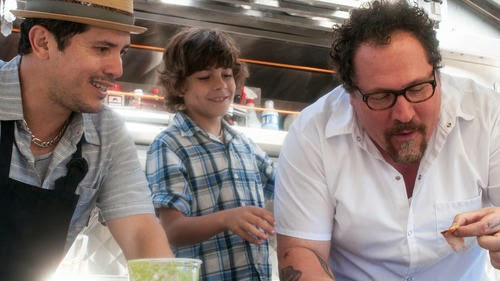
The chef, Carl Casper, is having a midlife crisis and gets fired from a trendy LA restaurant but finds culinary salvation – and Twitter popularity – by: 1) going full food truck 2) male-bonding with his son 3) male-bonding with other guys who appreciate his ways up carving up and grilling big slabs of meat and 4) remaining the center of intrigue for gorgeous women played by Scarlett Johannson and Sofia Vergara.

Much has been made about how Favreau, who directed blockbusters Elf, Ironman and Ironman 2, made this movie to return to his independent, small-movie roots. But the filmmaking in Chef “couldn’t be more Hollywood-minded,” says Ben Sachs, a critic for the Chicago Reader. Chef is “thin and bland” with its “sentimental plot and sitcom-ready one-liners would be right at home in a Billy Crystal vehicle.”
I’d add that the plot is cynically manipulated to complete an easy checklist of pop culture touchstones, including: foodie chic and food truck chic, Cuban sandwiches, tweeting your life, selfies, social media marketing, the genius hero’s messy industrial-style apartment and anything New Orleans, Texas barbecue or Austin music scene. There is one amusing cultural faux pas, pointed out by the LA Weekly: how AOL becomes relevant enough for a plot point by paying $10 million to buy a food writer’s blog.
But let’s get to Favreau’s curious depiction of men and women and what’s socially acceptable in terms of their bodies, weight and food consumption.
One writer for the Los Angeles Times picked up on how the film’s relationship to food portrays an overt sexism, but called this sexism “a good thing.” From the moment Casper walks into that prissy (read: female) trendy restaurant with an enormous dressed hog and “begins to carve out huge pink tenderloins with his chef’s knife,” Chef announces itself as a movie about masculinity, Charlotte Allen says.

“It’s about a man becoming a man.” All the big hearty slabs of meat on display are “alpha male food,” the kind of food men love to cook and eat.
Yes, there are plenty of scenes of Caspar carving up meat, slicing off hunks of it, whipping up inspired combinations of ingredients and sharing food, good times and near religious culinary reverie with male co-workers, his father-in-law, his son and even the movie’s antagonist, the male food writer who blasted him for his trendy LA restaurant inauthenticity. Caspar and his dudes get to scarf down food, chomp it loudly and smack their lips, with meat juices dripping off their fingers and the confectioner’s sugar from French Quarter beignets falling from their lips and chins.


Scarlett Johansson plays the hostess at the LA restaurant who has some kind of on-again, off-again flirtation/relationship with Favreau’s character. Vergara plays Caspar's rich ex-wife and mother of his adorable but neglected son. These two women strut into scenes, high heels clicking, cleavage heaving and smiling with a mix of exasperation but admiration and love. 

They also don’t eat – not much anyway. In a scene in a Cuban restaurant in Miami, Casper and his father-in-law go to town on the thick pulled pork and cheesy sandwiches; Caspar will adapt the recipe and sell it in his food truck. At that meal, Vergara sits by sweetly, picking at something on a plate that looks like a salad.

Once Casper gets his food truck up and running, and takes it to Miami, New Orleans and Austin, we get to see scenes of women – including women in bikinis – lining up at his truck to buy sandwiches. 

But in this film with so much pleasure in the rituals of preparing and eating food, there is really only one notable scene where a woman gets to put anything reaching basic-daily caloric requirements into her mouth. 

That’s in a scene where Caspar, iffy about having sex with Johannson’s hostess, stalls by whipping her up a beautiful bowl of pasta. (Incidentally, he uses a simple recipe that appears to incorporate olive oil, garlic, red pepper flakes and Italian parsley – a recipe I myself have made).


Johannson is seeing writhing on the sofa as she accepts the bowl and takes a taste. But let’s consider the serving size he slips to her. It looks like a delicate forkful, probably a portion that’s no more than a half cup. It's a sensible and potentially calorie-reducing portion, depending on Johansson's daily caloric intake. 

And there is nothing wrong with portion control, right? But the film doesn't show Favreau applying anything so self-denying as portion control to his male characters, notably Caspar who's headed into obesity territory. If his Caspar was making that pasta for himself, I bet it would be a case of noodles runneth over, a heaping two cups with layers of olive oil and freshly shaved Parmesan melting in.

And, even after Caspar gets dissed by the food critic for gaining weight, the chef shows no signs throughout the movie of thinking – like the rest of us – well, OK, maybe I should cut back for my health or so that I’ll be more physically attractive the significant others in my life. In his case, these are the hot restaurant hostess and the still hot ex-wife.

In fact, he continues to eat and cook and eat and stay overweight – all while rocketing to new heights of artistic and professional success. And, he gets his beautiful ex-wife back.

Nothing wrong with a movie showing that physical beauty and BMI are trivial compared with other human qualities like kindness and integrity. But I doubt that any  movie – or any movie in Favreau's limited world view – could imagine such a story for a female character. 

Instead, Favreau's Caspar – unlike a female character – suffers absolutely no consequences for being overweight and unattractive or in displaying no self-control about how much food he consumes. 


I saw Chef shortly after watching the now famous episode of Louis CK’s FX series, in which he picks apart his own reluctance to go out on a date with a pretty, funny, vivacious woman who happens to be overweight. The episode juxtaposes overweight Louis ducking her flirtations with him binge eating with a male friend, the two shoveling in so much food that’s it’s sickening. But shovel they do, vowing the entire time they’ll hit the gym, lose weight and get in shape after this final food spree.

But they’re guys, and being overweight and ugly – like Favreau’s Caspar – shouldn’t hurt them in the getting-laid department, especially if they are rich and successful.

Louis CK has been paired with various skinny, attractive women on his show, but in this episode he seems to show an awareness – lacking in Favreau’s Chef – of the double-standard in the entertainment world and in society when it comes to women, food and body size.

And in this world, average or even below-average looking dudes get to hook up with skinny-busty model-esque women. And these women have to stay model-esque skinny by not eating the Cuban sandwiches, slabs of barbecue or delicate beignets that Chef Carl Caspar wouldn't bother to put in front of them in the first place. 

June 2, 2011

Blasphemy! I like this rain in June and I didn't like the new Woody Allen movie


As I write this, a steady rain is falling outside my front window. I'm listening to the rain drops hitting the pavement of my cul-de-sac and the shiny green leaves of the camellia bushes. The air is cool but feels clean, new.

I love it.

This rain is supposed to make me depressed or upset that summer hasn't started yet and, that, weather-wise, it feels like we time traveled back to January. I've heard people gripe, including the KGO-810 weather guy Lloyd Lindsay Young. On Tuesday, he talked about how the weather was going to get "worse" this week because the rain was expected to continue and the temperatures would be 20 to 30 degrees below normal.

So, maybe he really thinks that or he's pandering to what he believes his audience wants to hear. When he advised listeners that there was a possibility of another storm coming in on Friday, I would have started clapping if I didn't have my hands on the wheel of my car.

As some of you know, I grew up in Walnut Creek, so I 'm accustomed to how the weather is supposed to be in the first week of June. Warm and sunny, although through June, we do typically get days of fog rolling in.

I always found the regular dry spell from April or May all the way through September and October to be oppressive. I don't mind our hot days, as long as the 100-plus days don't go on longer than a week, as they did during that incredible heat wave a few years ago. But 90-, 95-:, 100-degree weather? The better to hit Clarke Memorial Swim Center and do some laps.

But without the cleansing provided by an occasional batch of rain--which almost never happens during summer here--the blue skies above always start to grow brown layers of smog and muck.

I went to college outside Chicago, and, yes, experienced several bruising Chicago winters--something I never want to live through again. I also lived through the humidity of a Chicago summer. Couldn't do the humidity every summer the rest of my life. But with the humidity I could at least look forward to that promise of occasional summer storms, and those, to me, are soothing and exciting at the same time.

I like rain. It is active, and it can be romantic and dramatic, especially as you see storm clouds moving across the sky--the heavens massing for some grand announcement--and hear the wind blowing through the trees. I like rain in the fall, winter, spring--and summer. I loved the rainy season in Thailand where my husband and I lived for three years. Every day, a big storm would roll through Bangkok, dump rain, pound thunder, hurl lightening, sometimes flood the streets. It would definitely clean up the air, which in this sprawling Asian megalopolis was generally choked with the exhaust of hundreds of thousands of cars, buses, motorcycles and tuk-tuks clogging up the streets. When we lived up in Humboldt County, I loved going for walks on the beach or driving along Highway 101 as a winter storm was coming in over the roiling, steel gray Pacific Ocean.

For the most part I like the weather we have in Walnut Creek. I just wish we would get those occasional summer storms. This rain? Loving it. However, I am sorry if it's still raining on Saturday and it mucks up plans for the Chamber of Commerce's Art and Wine Festival or the dedication ceremony for the new 23 acres of open space along Acalanes Ridge.

Speaking of the romance of a rainy day, I saw Woody Allen's latest Midnight in Paris. His protagonist, Gil, played out by Owen Wilson, is made out to be a romantic, sympathetic guy. One signal that he is sensitive, thoughtful and therefore lovable is because he loves to walk around the streets of Paris in the rain. He thinks any city looks more beautiful in the rain.

On this point, I think the film hit the nail on the head. Yes, any city takes on a rich and more tender quality in the rain.

The rest of the movie? I heard KGO radio host Ronn Owens gush about it, and some friends have Facebooked or emailed about how wonderful and charming it is-Allen's best in years.

So sorry, I do not agree.

And, I'm someone who always loved Woody Allen and still love his early comedies (Take the Money and Run, Sleeper, Play it Again, Sam, Love and Death) and his forays into drama and more avant garde film. I recently watched Annie Hall for, like, the 50th time. My son loves Allen's early comedies and he liked Annie Hall. I can watch Manhattan, Hannah and her Sisters and Crimes and Misdemeanors again and again. And, yes, I've even sat through some of his "experiments" from that era (September anyone? His attempt at Bergman?) and came away thinking, well, at least that was interesting.

Another of his films I really like was Husbands and Wives, which he released in 1992 soon after The Scandal. That was when he was caught having an affair with the 22-year-old adopted daughter of his longtime lover, Mia Farrow. Some people couldn't watch Husbands and Wives after news of the affair broke, and then Mia accused him of molesting their daughter together. They thought the bitterness of the relationship between Allen and Farrow as married spouses too closely mirrored Allen and Farrow's real-life relationship. Because of Allen's betrayal, some people vowed never to see another Allen film again.

I found most of his movies since then to be disappointing, including Deconstructing Harry, Match Point, and Vicky Cristina Barcelona, all three of which had the critics and Allen fans swooning and proclaiming "Woody is back."

As an artist, Allen always lived in a certain rarified world of New York City's intelligentsia and social elite. But at least in his earlier films--probably Manhattan Murder Mystery and before--he tended to have an ear for how people in this rarified world lived and talked. So, you could believe that we were watching human beings really struggling with the challenges of modern romance and other moral questions--and you would relate and you would care.

Even Allen's great female characters had dimensions that made them intriguing and lovable--even as much as he was often criticized for not being able to adequately write female roles. I'm talking Diane Keaton in any of her roles. Same goes for Dianne Wiest in Hannah and her Sisters, and Mia Farrow in many of hers. Farrow was a smart and beautiful documentary film producer in Crimes and Misdemeanors and wonderful as the passive-aggressive wife in Husbands and Wives, her last film with Allen. Angelica Huston as the doomed stewardess lover of Martin Landau in Crimes and Misdemeanors and Judy Davis as the uptight, perfectionist wife in Husbands and Wives also were brilliant. Sorry, I didn't appreciate Mira Sorvino in her Academy Award winning performance in Mighty Aphrodite (1995) because--well--this was one of those Allen movies where I think he had lost his ear for how people talk, act, move through their lives. He also showed his increasing reliance on stereotypes and outlines of characters, rather than on putting in the work of creating real charaters.

No, I wasn't crazy about Match Point or Vicky Cristina Barcelona either. More blasphemy!

They were fine, but not great. Crimes and Misdemeanors handled the story and moral implications of a man dispatching an inconvenient mistress much more intelligentally, truthfully and succinctly than than Match Point, which was filled with a generally unconvincing story line, stock characters, and an annoying, one-dimensional supposed-to-be-smoldering Scarlett Johansson as the needy, neurotic mistress.

Yeah, I could see Jonathan Rhys-Myers' social climbing tennis player sleeping with her once, but becoming obsessed with her? Allen wrote a one-note, one-dimensional role for Johanssonmm, said to be his one-time muse.

Her character became boring after about 10 minutes, as did most everyone else in the movie. These characters and their desires and struggles stopped convincing me after about a half hour.

The key word here is "convincing," a word emphasized by the British novelist E.M Forster in his book Apects of the Novel, one of the most influential books ever written about the craft of story telling and character development.

No, the characters don't need to believable in the sense that you believe these are real people or that their situations are based on real life. We are talking about fictional characters. But for any fiction to work well--whether it's a hack Hollywood script, a literary novel, a Lifetime made for TV movie--the characters and their situations neeed to be convincing.That's Forster's big message.

Allen's characters in Midnight in Paris are so far from convincing in that they are one-dimensional, obvious, stock. They seemed to be thrown together by a an artist, working at hack levels, to create characters and a story. The contrivance and manipulation seethes out of this film.

So, Owen Wilson plays the hack Hollywood writer who no longer wants to be a sell-out and wants to do "real" writing-as in literary fiction? Please. That's so old school.

Then there is his nagging, rich bitch fiance, played by Rachel McAdams who--guess what, surprise surprise!--doesn't like to walk in the rain. That the Owen Wilson character tries to stick with her for more than 10 minutes of this film defies fictional logic.

The Hemingway in Paris in this time travel movie also played into every CliffNotes stereotype that people have of Hemingway. Maybe I'm a fool, but I would have expected a more creative and subtle character from Allen. But, as I've come to learn over the years, Allen's writing has become lazy--so lazy that this Hemingway deliverss a lines containing the line "grace under pressure." Ha ha ha ha ho.

Of course, Marion Cotillard, as the fashion student out of the 1920s who enchants Wilson, was beautiful. What's not to love about Cotillard, with her fatalistic, intelligent loveliness? Now that Catherine Deneuve has slowed down her film output, I nominate Cotillard as the most beautiful woman alive working in film. But I lost respect for her Adriana character, as well as Kathy Bates' Gertrude Stein, when the two women gushed about the opening sentences from the "literary novel" Wilson's Gil--Allen's Midnight in Paris' personal stand-in--shared with them. The writing in Gil's novel is almost as uninspiring and unoriginal as Allen's writing for his Midnight in Paris characters.

I know people who tried to make it as "hack" Hollywood screen writers. It's high-risk, and its super hard work. I happen to think there are great writers working in Hollywood today, especially those penning for some of the top-quality cable TV shows: Mad Men, Breaking Bad, The Wire. Also, the literary publishing industry is, itself, a bit of a popularity contest and a racket. If Allen is saying that gravitating toward the literary publishing world is somehow more noble and pristine than Hollywood, well, that view is rather old-fashioned and naive. Maybe that sentiment would have worked in the 1930s when F. Scott Fitzgerald was supposedly abandoning his talent and ideals to write scripts in Hollywood.

But to pose that position for characters in a story that starts out set in 2010? Sorry. This sort of conceit shows how Allen has lost touch with the contemporary cultural currents. That is what was so exciting about his films in the 1970s, 1980s and early 1990s. They did feel like they had their fingers on the pulse.

There's a whole generation of Woody Allen fans who want to fall in love again with Woody Allen. These are the people who crowded the theaters at the Embacardero Center Cinema and the Dome at Pleasant Hill's Cinearts over the weekend. Gosh, these fans remind me of patient, wishful lovers in a really good Woody Allen film. They will convince themselves that anything their idol produces is charming, lovely and original. I say this as someone who continues to try out Allen's films, hoping to find a spark of charm, loveliness and originality, and walking away disappointed and annoyed.

I think his writing has become lazy, his connection to humanity has become even more isolated, and the results are tedious and almost insulting to the intelligence of his audiences. He could do better--but maybe he doesn't care. He's rich, he's living his comfortable life. He's now 76, so maybe he wants to keep his hand in movie making but without a real artist's effort to take risks and push the boundaries.

I have to ask, who is the hack here? His Midnight in Paris protagonist, Gil who has been writing scripts in Hollywood? Meanwhile, Allen, the indie film elder statesmen, continues to think he can write in cliches and stereotypes because he has audiences who will buy it. You can call me a disappointed, bitter ex.